Most people who visit the Kruger National Park experience it the same way. They book a gate entry, drive in, and for two or three days they move through one of Africa's oldest and most significant wildlife sanctuaries — 19,485 square kilometres of protected bush that has been managed as a game reserve since 1898. They watch elephant at the waterholes. They stop the car when the ranger stops. They eat dinner at a rest camp with the sound of the bush on the other side of the perimeter fence. Then they drive back out through the gate they came in.
Close to two million people made that trip in 2024 alone. On Google and TripAdvisor, the park is rated 4.7 out of 5 — across a combined total of more than 23,000 reviews. It is not an undiscovered corner of Africa. It is one of the most visited and most consistently praised wildlife destinations on earth, and it has a golf course on its southern boundary.
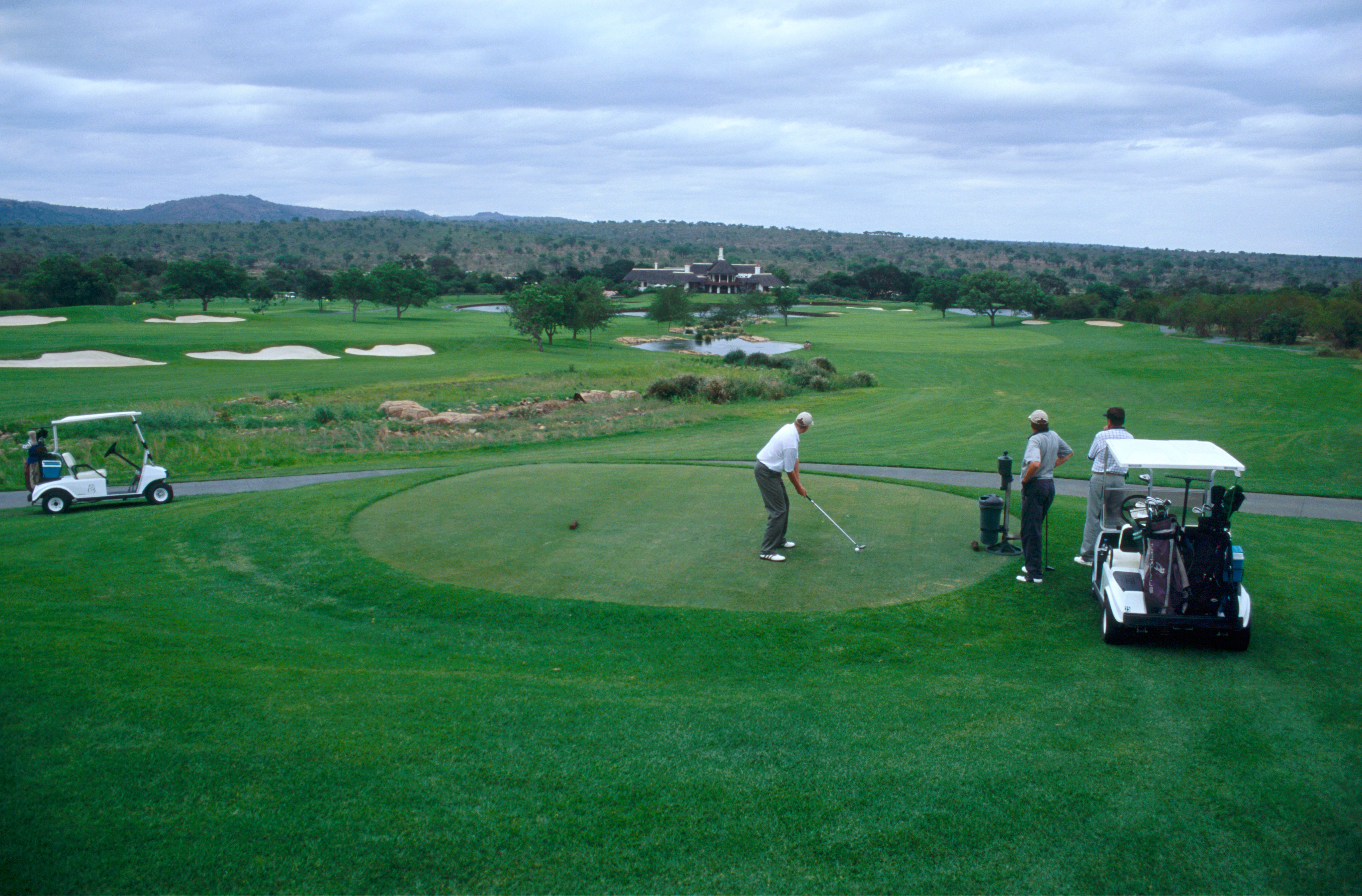
Leopard Creek Country Club sits on that boundary's fence line. The course begins where Kruger ends — and in practice, that distinction is difficult to maintain.
You clear the Malelane Gate and your caddie is already waiting. Not in a car park — at the gate itself, at the edge of the reserve. From this point, you are not a visitor watching Africa through a windscreen. You are about to tee off on a course that shares its boundary with the Crocodile River and everything that comes to drink from it.
This is the entry point to Leopard Creek. Most golfers who visit South Africa leave without finding it. That is about to change.
A Course on the Southern Edge of Kruger
Leopard Creek was designed by Gary Player — nine-time major champion, South African by birth, and one of the most prolific golf course architects in the world — and opened in 1996 on the southern boundary of the Kruger National Park, near Malelane in Mpumalanga.
The course plays to a par of 72 across 18 holes, about 6,500 metres from the back tees by the club's own 2024 scorecard and course guide. Golf Digest ranks it among the world's 100 greatest courses (2022–23 rankings) — one of only two South African courses to appear on that global list, and consistently rated among the top two in the country. The standing is earned not through marketing but through the particular quality of what Player produced here: a golf course that is genuinely difficult to separate from the landscape it occupies.
What makes that landscape significant goes beyond the Kruger fence. In 2002, South Africa, Zimbabwe, and Mozambique signed an agreement creating the Great Limpopo Transfrontier Park — a joint conservation area of approximately 35,000 square kilometres that combines Kruger with Zimbabwe's Gonarezhou National Park and Mozambique's Limpopo National Park. The fences between the three territories have progressively been removed to restore migration routes that colonial-era borders had severed. Elephant herds that once pressed against hard boundaries now move between three countries across corridors that existed long before the borders did. The three governments manage the combined area jointly, sharing ranger resources, anti-poaching intelligence, and conservation protocols across sovereign lines.
Kruger itself holds one of the largest elephant populations of any protected area in Africa — a herd density that is a direct consequence of the space and protection the transfrontier arrangement provides. When an elephant crosses the fairway at Leopard Creek, it may have walked from Mozambique. The wildlife that visits is not incidental to the location. It is the location.
What You Are Playing Into
The Crocodile River is not a decorative water feature. It is habitat — crocodiles are present in the water; hippos move between the river and the surrounding bush. Elephant, buffalo, and antelope have been documented on the course. When the Alfred Dunhill Championship was held here on the DP World Tour, marshals managed wildlife near the playing area as a matter of course.
"There is just nothing like Leopard Creek in the world of golf."
Ernie Els — Alfred Dunhill Championship
The 13th: A Hole with Kruger in the Background
Of the 18 holes at Leopard Creek, the 13th has attracted more cameras and more commentary than any other. It is a par-five of just over 500 metres that begins with an elevated tee shot across a stream that splits the fairway, while the ground slopes right-to-left toward a water hazard running the full left side of the hole.
The green sits 32 metres above the Crocodile River.
From the putting surface, you look directly into Kruger National Park. The far bank is Kruger territory. There are no fences between the green and the park. When the December tournament was played here, spectators at the 13th could watch the game in both senses: the tournament, and the animals moving on the far bank.
It is, by most accounts, one of the finest vantage points available on any golf course anywhere. The photographs do not capture it accurately, because they cannot include the sound — the river, the birds, and the particular quality of silence that exists at the edge of a game reserve at six in the morning.
The Alfred Dunhill Championship
Leopard Creek has been the primary home of the Alfred Dunhill Championship on the DP World Tour — the flagship December event on the Sunshine Tour co-sanctioned international circuit. In December 2024, South Africa's Shaun Norris won the tournament at Leopard Creek after coming from six strokes back in the final round to take the title by one shot.
The 2025 edition of the Dunhill has moved to Royal Johannesburg, a decision taken to allow Leopard Creek to recover from the demands of double-hosting — the championship alongside the R&A Africa Amateur Championship had put significant pressure on the course surface during the southern summer. This is not a departure from Leopard Creek's identity as a tournament venue. It is a measure of how seriously the club manages the condition of the course.
For visiting golfers, the tournament history matters for one practical reason: the course is set up and maintained to professional standards. The green speeds, the rough management, the condition of the bunkers — these reflect what a DP World Tour host venue requires. You are not playing a resort course that happens to have an interesting setting. You are playing a tournament course that happens to be inside a game reserve.
The Malelane Arrival: A Different Way In
Most golfers who visit South Africa travel through Johannesburg and head toward the Garden Route, or they fly to Cape Town and work their way east. Leopard Creek requires a different approach — and the approach is part of the experience.
Malelane is a small border town on the southern edge of the Kruger National Park. The drive from Johannesburg takes approximately four hours. From Kruger Mpumalanga International Airport near Mbombela — formerly known as Nelspruit — it is under an hour. Many guests combine Leopard Creek with a night or two inside Kruger itself — staying at one of the private lodges along the southern boundary and moving between the game reserve and the golf course over two or three days.
The Malelane Gate is one of the quieter entry points into Kruger. Arriving early in the morning to reach the course, it is not unusual to encounter game on the road before you reach the first tee. This is not a designed element of the experience — it is simply what the gate offers. By the time you are standing on the first tee, you have already been inside Africa in a way that a flight into Cape Town and a drive to the Winelands does not replicate.
Kruger does have its own golf course — a 9-hole layout at Skukuza rest camp, unfenced and operating inside the park boundary. We have written about it. Leopard Creek is a different proposition: a full championship course on the park's southern edge, maintained to DP World Tour standards and accessible to visitors who are not staying inside Kruger at all. The two courses share a postcode and offer two entirely different reasons to make the trip.
Course Fact Panel
Leopard Creek — At a Glance
| Location | Malelane, Mpumalanga, South Africa |
| Designer | Gary Player |
| Opened | 1996 |
| Par | 72 |
| Length | About 6,500 metres (back tees; club scorecard and course guide, 2024) |
| Holes | 18 |
| Setting | Southern boundary of the Kruger National Park |
| River boundary | Crocodile River (eastern boundary) |
| Tournament | Alfred Dunhill Championship, DP World Tour (host in 2022, 2023 and 2024; the 2025 edition was at Royal Johannesburg) |
| Notable hole | 13th — par-5, green 32m above the Crocodile River |
| Wildlife | Elephant, buffalo, hippo, crocodile, antelope recorded on and adjacent to the course |
| Nearest airport | Kruger Mpumalanga International (KMIA), approximately 65km |
Green fees are available directly from Leopard Creek Country Club. Rates change seasonally — confirm current pricing at booking.
Planning Your Round
Leopard Creek is not a course you drop into on a passing itinerary. It rewards a planned stay of two to three nights in the area — enough time for at least one round, a game drive inside Kruger, and the drive south along the Crocodile River at dusk, which produces a quality of light that photographers and non-photographers alike tend to stop the car for.
Building a golf itinerary around Leopard Creek? STA will design the programme around your travel window — combining the course with a Kruger safari, the KZN coast, or any other combination that fits your trip.
Enquire with STAIt pairs naturally with a broader KwaZulu-Natal or Limpopo golf programme. If you are combining Leopard Creek with Prince's Grant and Zimbali on the KZN coast — two championship courses within range of the Manyoni Private Game Reserve and Phinda — you have the architecture of a ten-day trip that covers two of South Africa's great golf corridors and two of its great wildlife ecosystems.
Golf is the anchor of every Swing Through Africa itinerary — but it is not the whole of it. STA programmes are built on the understanding that Africa's most compelling travel experiences happen on and off the course: on the fairway at Leopard Creek, yes, but also in the safari vehicles at Phinda, on the beaches of the Wild Coast, in the winelands above Franschhoek, and in the cultural landscapes of KwaZulu-Natal's battlefields and mountains. Across 11 African countries, STA curates golf-led journeys that are as much about where you sleep, what you eat, and what you encounter after the round as they are about the scorecard.
Leopard Creek is one of 33 courses on the STA Africa Golf Bucket List — a curated selection of the continent's finest courses, from the Garden Route to the Indian Ocean coast of East Africa. View the full Bucket List here.
We will be publishing in-depth profiles of each course in the months ahead. Follow STA on LinkedIn to be notified when the next one goes live.
