Course Profile
Almost everything written about Prince’s Grant ends on the tee of the 15th. It is a par 5 that drops from high ground to a green at sea level, with the Indian Ocean behind it. It is a fine hole, and it has been photographed from every angle. If you are visiting, play it and take the picture. If you live on this coast, you have probably taken it already.
Either way, the hole to talk about is the next one.
The 16th is called Paddyfield. The club’s own history says the ground it plays across was once a rice plantation. To understand why rice was growing on a golf course in cane country, you have to go back further than the golf.
On 20 October 1856, a deed of grant from Queen Victoria gave George Wilson Prince a farm called Hyde Park: 3,354 acres in what was then the British colony of Natal, near what is now KwaDukuza. The golf estate sits on part of it, and still carries his name.
The land was later owned by the Bodasing family. Babu Bodasing arrived in South Africa from India in 1874 to work as a labourer in the sugar fields. By his death in November 1919, according to Compleat Golfer, he was reputed to be one of the wealthiest businessmen in Durban. According to Estate Living, it was Babu Bodasing who first planted rice here. The estate’s address today is 1 Babu Bodasing Avenue.
When the land was sold for golf, it was sold by Raj Bodasing. Compleat Golfer reported in 2018 that he was still a shareholder and director of the estate.
The golf started with one man’s idea. According to Compleat Golfer, Guy Smith, a Pietermaritzburg lawyer, attended the Masters and was inspired by Augusta National, and the idea goes back to 1976.
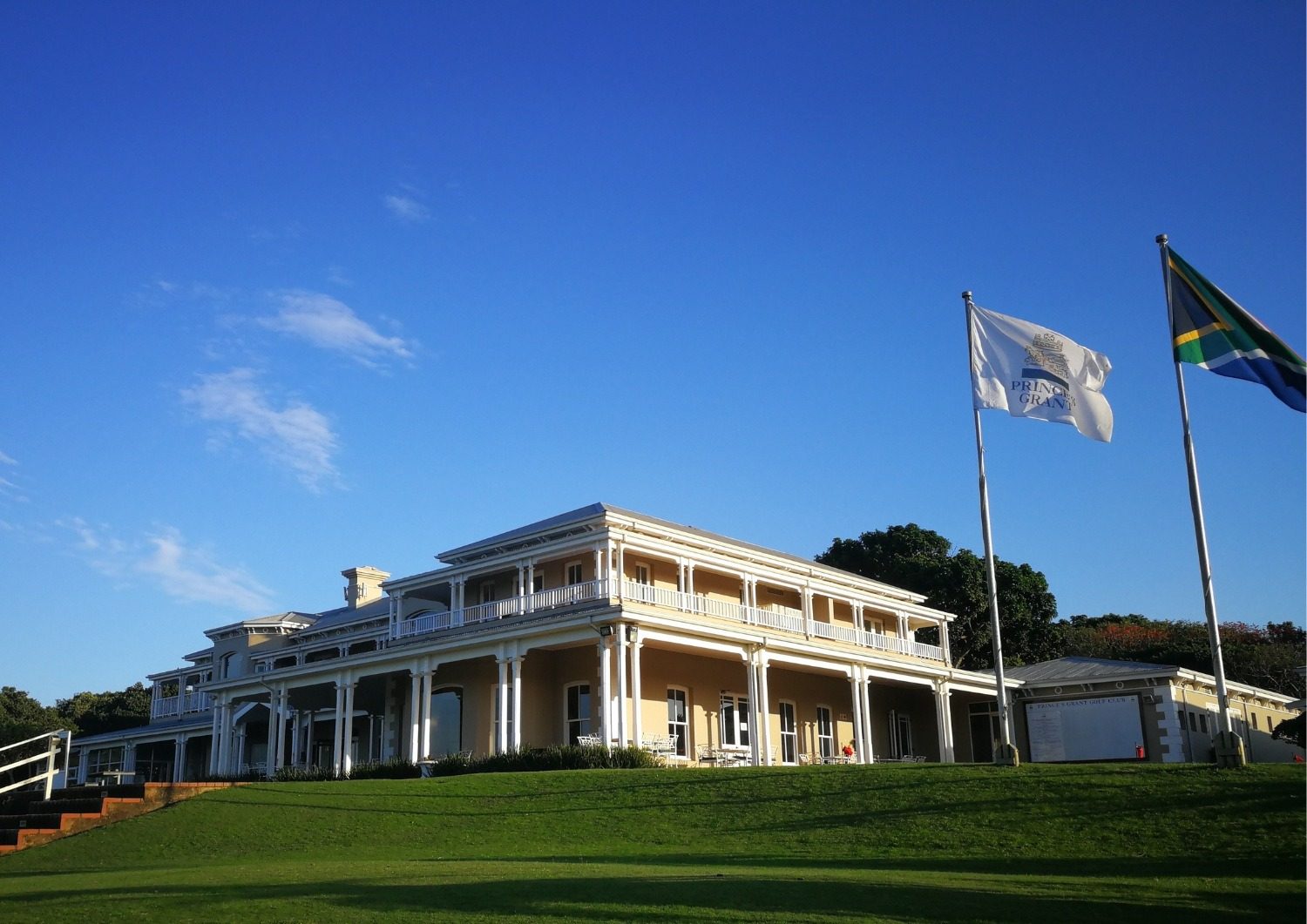
It took a long time to become real. Construction began in 1992 under Peter Matkovich’s design. Jeremy Stubbs, a local landscaper, was hired to put indigenous plants back onto farmed land. The course opened in 1994, and the clubhouse followed that November.
Smith was frank about the early years. “We were basically insolvent,” he told Compleat Golfer. Compleat Golfer reports that in 1999 the course was sold to its homeowners.
Building a golf course on an exposed ridge above the sea came with a problem nobody could plan away. When the grass went in, as Compleat Golfer told the story in 2012, “the wind would blow the tufts of grass clean out of their bedding.” Windbreaks went up, and even they could not hold all of it.
The wind has not gone anywhere. The 14th, the highest hole on the property, is called Windy. The 9th plays from an isolated tee where, as one Compleat Golfer reviewer put it, the wind is “even more difficult to gauge.” A reviewer on the SA Top 100 Courses site gave simpler advice in 2024: “Don’t play late afternoon, as the wind does have an impact.”
In summer, add the heat to the wind. Book the morning.
The course was built on paspalum, a grass that copes with salt air. In recent years the greens have been overseeded with bentgrass, according to an SA Top 100 reviewer in March 2026. That is part of a wider change on this coast: Zimbali Lakes chose bentgrass greens from the start, and Durban Country Club moved to bentgrass in its rebuild. That rebuild has a story of its own, and this series ends with it.
The club completed a reconstruction of the course in November 2020. It sits at No. 31 in the SA Top 100 Courses list for 2026.
According to Estate Living, the estate is home to bushbuck and blue duiker. A golfer out early may see them. Nobody can promise it.
STA builds every journey outward from a course. Most of what is written about Prince’s Grant sends golfers there for the view from the 15th tee. We include it for the whole of the land: a Victorian land grant, a family that came to work the cane and went on to own the ground, a lawyer who would not let an idea go, and a wind that shaped the course before anyone hit a ball on it.
Each reader will find something they recognise. An American golfer will recognise the idea that started it, which came home from Augusta. A British golfer will recognise the name on the deed, which is Queen Victoria’s. A South African golfer will recognise the name in the estate’s address, which is Babu Bodasing’s.
Play the 15th for the photograph. Walk the 16th for the history.
| Location | New Guelderland, KwaDukuza (Stanger), KwaZulu-Natal north coast |
| Design | Peter Matkovich; landscaping by Jeremy Stubbs |
| Construction / opening | Construction from 1992; opened 1994; clubhouse November 1994 |
| Ownership history | Sold to its homeowners in 1999 (according to Compleat Golfer) |
| Grass | Paspalum, with greens overseeded with bentgrass |
| Holes to know | 9th (exposed tee), 14th “Windy” (highest point), 15th (par 5 to a green at sea level), 16th “Paddyfield” |
| Ranking | No. 31, SA Top 100 Courses, 2026 |
Begin your journey
Swing Through Africa builds each journey outward from the course you choose. Tell us which one is yours, and a member of the STA team, not an automated system, will reply within 72 hours.
Start your enquiry