Course Profile
Most golf courses are built to be walked. Zimbali Country Club was built on the assumption that nobody would try.
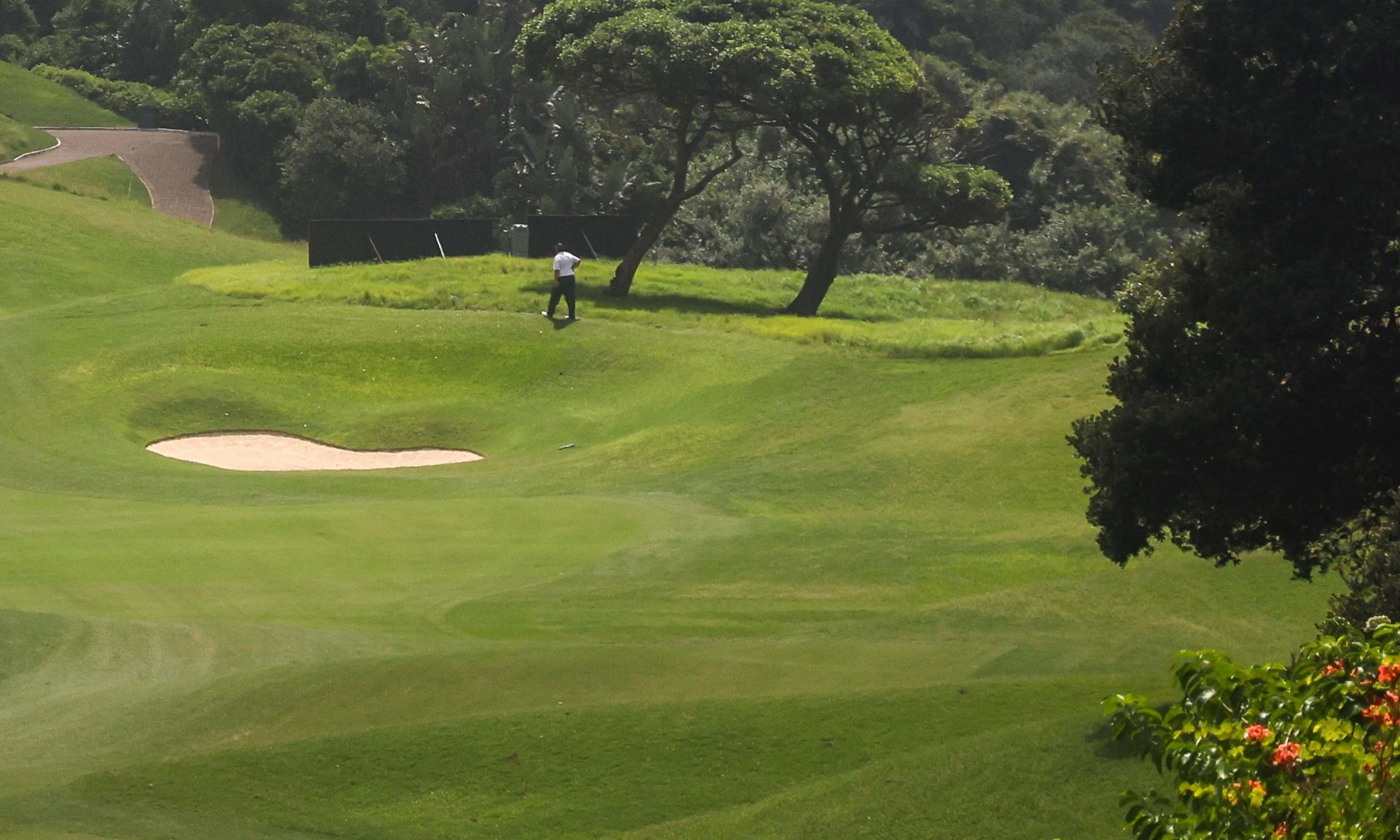
It is a cart course, and the ground explains why. Of its eighteen holes, only two are flat: the 4th and the 6th, which sit next to each other at the low end of the property. Everything else climbs, drops or turns across a slope. Golf Digest quotes the course’s designer, Tom Weiskopf, on the site: “I had never before worked with land where so much elevation had to be taken into account.”
Weiskopf had seen a lot of land by then. He won the Open Championship in 1973, the same year he won the South African PGA Championship. He went on to build them too. GolfPass credits him with 70 designs and co-designs around the world. With his design partner Jay Morrish he laid out Loch Lomond in Scotland, No. 49 in Golf Digest’s World’s 100 Greatest Courses for 2026 to 2027 and host of the 2000 Solheim Cup, and the Stadium Course at TPC Scottsdale in Arizona, home of the Phoenix Open since 1987 and of its enclosed par-3 16th. A British golfer may know the first; an American will know the second. A South African golfer can play his work without leaving the country: Planet Golf lists Zimbali as his only course in Africa. The course opened in 1998. Weiskopf died in August 2022.
The course plays in two halves. The early holes are open, with the Indian Ocean in view. The par-3 5th plays steeply down towards the sea, and an SA Top 100 Courses reviewer wrote in 2025 of tee shots deviating by 40 metres against the gusts.
Then the course turns inland. By the club’s count, the holes from the 12th to the 18th run through the estate’s indigenous coastal forest.
The 14th is where Weiskopf used the carts to do something a walking course could not. It is a par 3 reached by driving up a steep path into a gap in the forest, and then playing back down to the green. It is an odd hole, and a memorable one.
The 18th is 442 metres, and according to SA Top 100 Courses it was a favourite of Weiskopf’s.
The clubhouse entrance keeps something that was on the site before the golf: the remains of a ruined farmhouse, framed around a wild fig tree, according to SA Top 100 Courses. Before the estate, this was a sugar cane farm, and BusinessTech reports that the first plots were not sold until 1996.
The estate describes eight vegetation types on its land, from pioneer dune plants to tall dune forest. It is home to bushbuck, blue duiker, vervet monkeys and banded mongoose, and it records more than 260 bird species. A golfer who keeps an eye on the edge of the forest may see some of them. Nobody can arrange it.
Not everyone loves it. Planet Golf’s reviewer warns of “stifling heat and humidity” that “can make golf an uncomfortable experience” here.
That is fair, and it applies most in summer. The answer is the one the course was designed around: take the cart, take water, and book early. The closing holes run into the forest, and in summer the shade is worth having.
According to SA Top 100 Courses, the fairways are Royal Blue cynodon and the greens are paspalum, both warm-season grasses. The greens are not the original ones. All eighteen were replanted in a seashore paspalum called Sea Isle 2000, in a project the Cape Argus reported as completed in February 2007. The same report called the grass’s salt tolerance its most outstanding feature. Zimbali Lakes, the newer course that shares the name, chose bentgrass greens. Two courses sharing a name, more than a quarter of a century apart, made two different bets on the same climate.
For a while, visiting golfers could rarely play here. According to SA Top 100 Courses, Zimbali became a members’ facility in 2020. In early 2026 it changed its policy and began taking day visitors again. In February 2026, Blanche Lamprecht, the club’s general manager at the time, told the North Coast Courier that a trial in 2025 “was a success, so we changed our policy at the beginning of the year.”
At the time of that report, visitors could book up to 28 days ahead, with some times held back for members, including Friday.
For a golfer who lives on this coast, that is the news: a course that had been largely members-only since 2020 can be booked again. For a golfer flying in, it means the only course in Africa that Planet Golf lists for the 1973 Open champion is back on the itinerary.
STA builds every journey outward from a course. Zimbali earns its place for a reason that is easy to check and hard to copy: by Planet Golf’s list it is Tom Weiskopf’s only course in Africa, on ground he said had more elevation than any he had worked with. It is also newly open again.
The flat holes are the 4th and the 6th. Enjoy them.
| Location | Zimbali Estate, KwaZulu-Natal north coast |
| Design | Tom Weiskopf |
| Opened | 1998 |
| Getting round | Cart course |
| Flat holes | Two: the 4th and 6th |
| Holes to know | 5th (par 3 down towards the sea), 14th (par 3 up into the forest), 18th (442 metres) |
| Grass | Royal Blue cynodon fairways; paspalum greens (SA Top 100 Courses) |
| Ranking | No. 18, SA Top 100 Courses, 2026 |
| Visitors | Day visitors welcomed again from early 2026; some times reserved for members |
Begin your journey
Swing Through Africa builds each journey outward from the course you choose. Tell us which one is yours, and a member of the STA team, not an automated system, will reply within 72 hours.
Start your enquiry